Physics and all that
Physics for the mathematical non-physicist
Conservation Laws Part I (Classical Particles)
This will hopefully be Part I of a multi-part series on the relationship between symmetry and conservations laws in Physics. More specifically it’s a bit of a high speed survey of aspects of that topic that I think are neat and also understandable. I won’t assume much physics knowledge, but I will assume a certain level of mathematical sophistication. The aim is for this to be understandable by a mathematically educated non-physicist. Unfortunately, every physicist thinks they’re being understandable and rarely is that true. I’ll do my best.
What are conserved quantities?
A discussion of conservation laws best starts with some definition of what is meant by that. Consider some classical particle As a matter of terminology, when I say an equation is for a classical particle what I really mean is that this equation governs the motion of the center of mass of some body. subject to net force F(x,˙x,t). The evolution of such a particle is governed classically by Newton’s equations, i.e. m¨x=F(x,˙x,t).
Suppose we can define some functional I[x(t)] such that for any trajectory xi(t) which solves the Newton equation we necessarily have that ddtI[x(t)]=0. Any quantity that satisfies this condition is said to be a conserved quantity of the problem or a constant of the motion.
 Why might we care about such things? One answer is to appeal by example to things that one already believes to be useful: energy, momentum, angular momentum are all often conserved quantities when solving certain physical problems. More generally, the conserved quantities allow us to reduce the work of solving Newton’s equation and to classify the types of solutions that can exist.
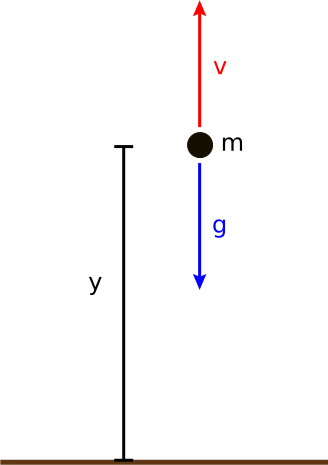
Let’s consider a simple example: a particle moving vertically under the influence of gravity. In this case, Newton’s equation is m¨y=−mg,
Conservative Forces
We can in fact further generalize the above quantity E by introducing the idea of a conservative force. We say that a force is conservative iff (if and only if) it can be written as the gradient of a scalar function i.e. F=−∇V.
A common way of picturing a particle feeling a conservative force is a ball rolling along some landscape of hills
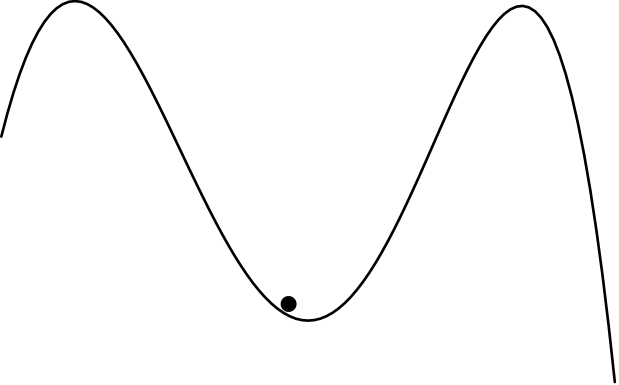
The behavior of the particle more or less follows our intuition of what the ball should do (neglecting friction) because, of course, gravity is a conservative force. For an object near the surface of a massive body (e.g. the Earth) we can write the force due to gravity as −mgˆy=−∇(mgy) where ˆy is a unit vector in the vertical direction. If we now suppose that the particle smoothly rolls along some surface with a profile given by the function y=f(x) we see that it will have a potential energy V(x)=−mgf(x)
A toy example
As an example to test things out on as we introduce them, we will consider the venerable Simple Harmonic Oscillator (SHO). If you’re already familiar with simple harmonic motion feel free to skip this part.
The system
The classic SHO problem consists of a point particle of mass m subject to a conservative potential V=12mωx2.
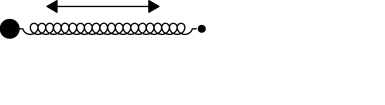
We may immediately see that such a force is conservative. To wit We’ll see in a second why I write k as mω2 above. F=−∇(12kx2)=−∇V⟹V(x)=12kx2
Why is this potential considered such a staple in physics? Well let’s suppose we have any system with a stable equilibrium. Well what does it mean to be in stable equilibrium? Imagine that we place a particle at that equilibrium and perturb it slightly. If we push the system slightly away from this equilibrium position the force of the system will push it back. For a conservative force this is equivalent to saying that a point of stable equilibrium is one where the potential energy V is at a local minimum (convince yourself of this).
Now for our generic system near a stable equilibrium, we can expand the potential in a Taylor series Or the suitable multidimensional Taylor series. Let’s not muck about with multiindex notation. as V=V0+V1x+12V2x2+⋯
Solution
Looking at the case of the spring system we can see why I named the constants as I did. In this case Newton’s equation is m¨x=−ddx(12mω2x2)=−mω2x.
Now for our toy example, we’re going to consider something slightly more complicated: consider a ball tied to spring which can move radially and axially with respect to the spring. The spring will provide a potential in the radial direction but the system is totally free in the angular direction. This setup can be described in terms of the potential Vtoy=12mω20(|r|−r0)2=12mω20(√x2+y2−r0)2.
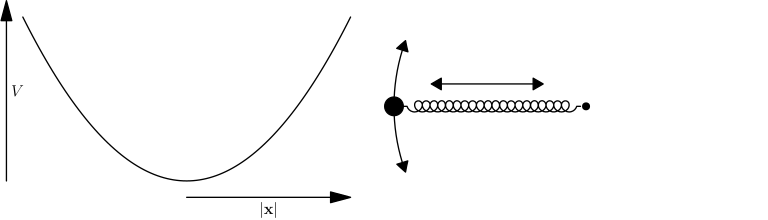
We’ll return to this model later as test ground to illustrate some of our conclusions, but for now lets move on to more theory.
Lagrangian Mechanics
For the purpose of investigating conserved quantities it turns out that there is a more useful framework of looking at classic mechanics. In fact, one can reproduce all classical physics from the following formalism
There is a functional S=∫dtL(t) of the trajectory x(t) called the action (L is called the Lagrangian). The classical trajectory of the particle is the one at which S is stationary.
This goes by the name of Hamilton’s Principle or the principle of least action. It really should be called the principle of stationary action or perhaps the principle of extremal action, but what can we do? This leads to a theory, known as Lagrangian mechanics, in which all properties of the system can be obtained from a single master object, the action.
Alternatively, one may consider Lagrangian mechanics in the following way. The Lagrangian of a system corresponds to a (sufficiently nice) rule for assigning a number to every possible history (past, present, and future) of the system. The trajectory that the particle will actually follow is the one such its assigned number is extremized Again, really we just need the action to be stationary. We’ll see shortly how to define that. (consistent with our boundary conditions). We can then say that different physical systems just correspond to different rules for assigning numbers to histories. In this way Lagrangians can be seen as complete descriptions of physical systems.
The general form of the Lagrangian varies from system to system but for a point particle feeling a conservative force (F=−∇V) the Lagrangian is L=T−V,
To see how this relates to Newtonian mechanics requires a detour through the calculus of variations. Given my definition (and notes) above you might ask: how does one find a stationary ‘point’ of a functional? For a single variable function f at an extremum or inflection point (excluding boundary points) we have dfdx|x=x0=0.
We can apply the same idea to the notion of a stationary trajectory. We say that ˉq(t) is a stationary function if for any smooth and bounded function η(t) which leaves our boundary conditions invariant. ddϵS[ˉq(t)+ϵη(t)]=0.
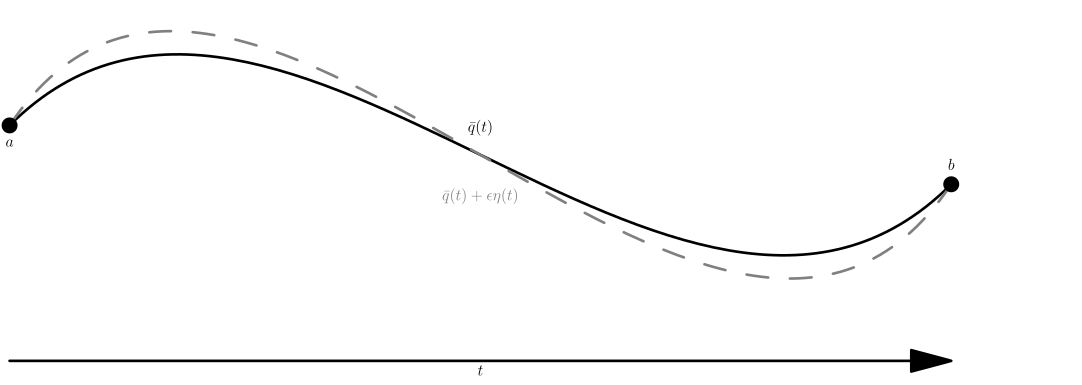
This provides a simple, intuitive way of bootstraping the notion of a derivatives and extrema into the space of trajectories.
Note that we have changed symbols to q(t) for our trajectory. This is to indicate that q doesn’t need to be a Euclidean position vector and instead can be an set of generalized coordinates. q for example could be the angle a pendulum makes with the vertical.
The connection to Newtonian mechanics
Let’s see what such considerations generally lead to for a Lagrangian which depends on the position and velocity of a particle (as well as potentially time). What follows is a somewhat tedious derivation of a general result. In actual work we only use the final product, but the derivation is worthwhile to follow for a couple of reasons. The most pertinent is that it illustrates the same sort of techniques that will be used a little later on to prove (a weaker version) of Noether’s theorem.
S[ˉq(t)+ϵη(t)]=∫badtL[ˉq(t),˙ˉq(t),t]=∫badtL[ˉq(t)+ϵη(t),˙ˉq(t)+ϵ˙η(t),t].
Taking the derivative with respect to ϵ and using the chain rule we find ddϵS[ˉq(t)+ϵη(t)]|ϵ=0=∫badt(∂L∂qη(t)+∂L∂˙q˙η(t))
T=12m˙x2V=U[x]L=12m˙x2−U[x]
and upon taking the derivatives
−dUdx=ddt(m˙x).
We have shown that, at least for the case of a particle in a conservative potential, Lagrangian mechanics subsumes the usual Newton’s laws that we learn about in intro to Physics. But I said that Lagrangian mechanics was a somewhat more useful framework from the perspective of symmetry. How is that?
Cyclic Coordinates
As a quick observation, let us suppose that the Lagrangian depends on ˙q but not q. What does the Euler-Lagrange equation for this system tell us? ∂L∂q0−ddt[∂L∂˙q]=0.
Noether’s Theorem
Now that we’ve established the efficacy of the Lagrangian formalism (at least to some degree), we can look at what is one of my favorite results in all of Physics. It goes by the name of Noether’s theorem after it’s discoverer, mathemetician Emmy Noether. Stated loosely Noether’s theorem is
Every continuous symmetry of the Lagrangian has an associated conserved quantity.
Let us suppose we can deform the trajectories from q(t) to q′(t′) but the action remains invariant. Specifically we assume that we shift the time of the trajectories t→t′=t+δt and we shift the trajectory itself by a small amount to q′(t′)=q(t)+η(t)=q(t′)+˜η(t′), where by defining ˜η we provide ourselves some way to decouple the effect of shifting time from that of deforming the trajectory. By assumption, the action of both trajectories is the same, i.e. S=∫badtL[q(t),˙q(t),t]=S′=∫b+δta+δtdt′L[q′(t′),˙q‘(t′),t′].
S′≈∫badt′L[q′(t′),˙q′(t′),t′]+L[q′(b),˙q′(b),b]δt−L[q′(a),˙q′(a),a]δt=∫badt′(L[q′(t′),˙q′(t′),t′]+ddt[L[q′(t),˙q′(t),t]δt]).
Renaming t′→t we can write the invariance of the action as ∫badt′(L[q′(t),˙q‘(t),t]−L[q(t),˙q(t),t]+ddt[L[q′(t),˙q‘(t),t]δt])=0.
Let us quickly recapitulate: if the two trajectories q(t) and q′(t)=q(t−ϵT)+ϵQ(t−ϵT) always lead to the same value of the action i.e. S[q]=S[q′], then we have that the quantity (∂L∂˙q˙ˉq−L)T+∂L∂˙qQ
That’s all well and good, but it’s fairly abstract. Let’s consider some specific examples. Specifically let’s look at a free particle feeling a conservative force. So the Lagrangian is L=12m˙q2−V[q]. One can readily verify that the action does not change if we shift time by an value T. This system is said to have time translation invariance. As a consequence, due to Noether’s theorem, we find
0=ddt[∂L∂˙q˙q−L]T=ddt[m˙q2−(12m˙q2−V)]T=ddt[12m˙q2+V]T=dEdtT.
where we have defined E=12m˙q2+V. Since T is totally arbitrary we have that E is conserved. Furthermore, E is nothing but the energy of the particle. Therefore, conservation of energy is nothing but the manifestation of the time translation invariance of the problem. More generally the function H=∂L∂˙q˙q−L
Let’s take a look at another example. Suppose we consider a particle in free space, subject to no external potential. The Lagrangian L=12m˙q2 depends only on the time derivative of the trajectory. We can therefore shift q(t) by any amount and the action is invariant. What do find then from Noether’s theorem? Well all terms drop out other than 0=ddt∂L∂˙qQ=ddt[m˙q]Q=dpdtQ=0
Since this is true for any Q we have that the quantity p=m˙q, the momentum, is conserved. This is the same result we obtained from examing cyclic coordinates. There is a small benefit here in that this result doesn’t depend on any clever choice of coordinates to obtain the result. So conservation of momentum is a statement that the problem is translationally invariant. In fact all of the common conservation laws that we run into in physics are related to symmetries (even conservation of electrical charge). Unfortunately, the more interesting and exotic conservation laws require more general formulations of Noether’s theorem. In particular, we’ll need to introduce Lagrangian mechanics for fields. Hopefully, this will be covered in Part II. As another example conservation of angular momentum mr×˙r is due to rotational invariance.
Let’s see what these concepts look like in our test system. Let us recall that we are imagining something like a ball attached to a springlike piston, which experiences a force in the radial direction, but is totally free to move tangentially to its pivot point. As we discussed before the this system is described by a conservative force with potential V=12mω2(√x2+y2−r0)2.
Obviously this Lagrangian is invariant under time translation. By a straightforward generalization to multiple coordinates Noether’s theorem then tells us that E=∂L∂˙xx+∂L∂˙yy−L
x=[xy]
we can rewrite the Lagrangian as L=12m|˙x|2−12mω2(|x|−r0)2.
(cosθ−sin(θ)sin(θ)cos(θ)).
This has the effect of also rotation ˙x→R(θ)˙x. Now, since R(θ) is an orthogonal matrix it preserves the norms of vectors and therefore the Lagrangian is unchanged under the is transformation. From Noether’s theorem we must then have a conserved charge. In order to find it, we consider the infinitesimal version of R(θ). For a an infinitesimal angle δθ we have
R(δθ)=1+(0−δθδθ0)+O(δθ)2.
Thus the rotation corresponds to the deformation
x→x−δθyy→y+δθx.
From Noether’s theorem, again generalized to multiple coordinates, we have a conserved quantity
Lz=∂L∂˙x(−y)+∂L∂˙yx=mx×˙x⋅ˆz.
This quantity is known as the angular momentum. As an exercise you may with to show that for a spherically symmetric 3-dimensional system the (pseudo)-vector The name pseudovector denotes the fact that the angular momentum behaves like a regular vector under rotations but not spatial reflections. L=mx×˙x is conserved.
Next time
Now that we’ve seen a bit about how symmetries and conservation laws behave in the classical mechanics of a single body we can move on to some more general cases. In the next post we’ll try to make our way toward considering how this relationship generalizes to quantum phenomena and what the consequences of that are. See you next time.